
If you are searching for a used Toyota 3Y engine for sale, focus first on the exact engine code, vehicle application, fuel system, and condition rather than choosing solely by price. The Toyota 3Y is a 1,998 cc, 2.0-liter four-cylinder engine, but the 3Y family includes carbureted, fuel-injected, emissions-equipped, and LPG variants.
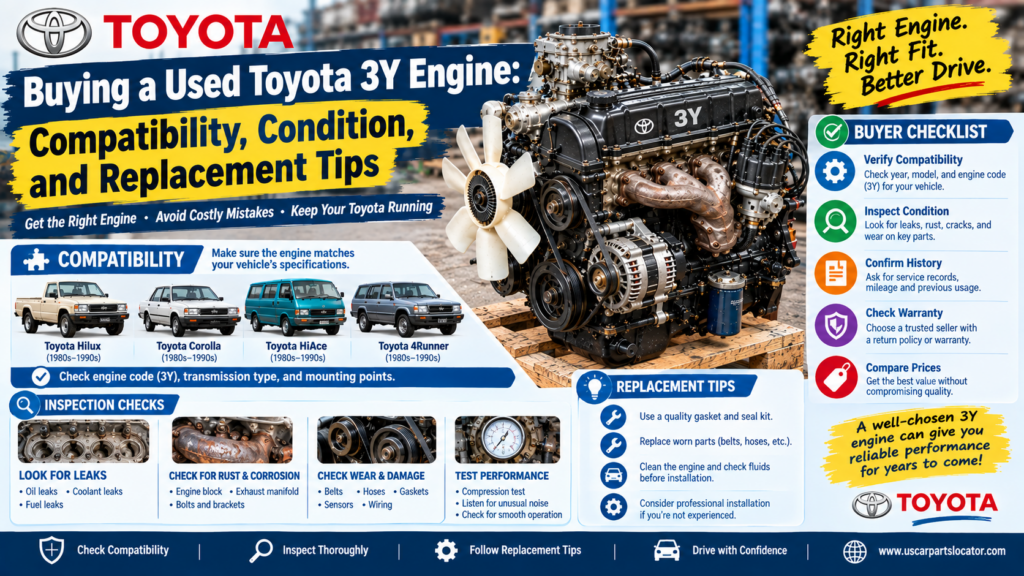
That means a replacement described simply as a “Toyota 3Y engine” may not be an identical match for your vehicle. Before purchasing, compare the original engine identification, donor vehicle, mounting arrangement, fuel system, accessories, and transmission compatibility. A few minutes spent verifying these details can help prevent an expensive mismatch.
What Is the Toyota 3Y Engine?
The Toyota 3Y belongs to the Y-series of gasoline engines. The standard 3Y uses an overhead-valve design with eight valves, an 86 mm bore, an 86 mm stroke, and 1,998 cc of displacement. Reference specifications for the standard version list around 88 PS and 155 Nm, although specifications vary between individual 3Y variants.
The engine was used in several Toyota applications, including certain HiAce, Hilux, Dyna/ToyoAce, and Crown models. Other versions of the 3Y family were fitted to additional Toyota vehicles and different market configurations.
For someone shopping for a Toyota 3Y replacement engine, this matters because the 3Y name represents a family of related engines rather than one universal configuration.
Common 3Y Variants
| Engine variant | Fuel/system | Displacement | What to verify |
| 3Y | Carbureted gasoline | 1,998 cc | Carburetor and accessory configuration |
| 3Y-C | Carbureted/emissions | 1,998 cc | Emissions-related equipment |
| 3Y-E | Fuel injected | 1,998 cc | Injection and electrical systems |
| 3Y-EU | Fuel injected/emissions | 1,998 cc | Fuel and emissions configuration |
| 3Y-P | LPG | 1,998 cc | LPG-specific components |
| 3Y-PU | LPG/emissions | 1,998 cc | Fuel and emissions equipment |
| 3Y-PE | LPG/fuel injected | 1,998 cc | LPG injection configuration |
The different variants demonstrate why displacement alone is not enough to establish compatibility.
Why the Engine Code Is So Important
When searching for a used engine, it can be tempting to search only for “Toyota 3Y 2.0 engine.” That can return engines with different fuel systems or applications.
For example, the standard 3Y is carbureted, while the 3Y-E uses fuel injection. The 3Y-P and 3Y-PE were designed for LPG applications.
Before buying, compare:
- Original engine code
- Replacement engine code
- Vehicle model
- Model year
- Fuel type
- Fuel-delivery system
- Engine mounts
- Intake and exhaust configuration
- Sensors and wiring
- Transmission connection
- Included accessories
If the engine code does not match, don’t automatically assume the replacement is unsuitable—or that it will fit. Instead, have the two configurations compared by someone familiar with the vehicle.
Which Vehicles Used Toyota 3Y Engines?
The standard 3Y is documented in applications including the third-generation Toyota HiAce, Hilux, Dyna/ToyoAce, and certain export-market Crown models.
The 3Y-E appeared in applications including certain Toyota Mark II, Hilux Surf, and other market-specific vehicles. The 3Y-EU was used in applications including Hilux Surf/4Runner and TownAce variants.
LPG versions were used in vehicles such as the Crown and Mark II, with the 3Y-PE also appearing in Crown and Comfort applications.
This broad application history is why the donor vehicle is useful information when evaluating a used Toyota 3Y motor.
How to Identify the Correct Replacement
Start With Your Existing Engine
Before searching, record everything you can about the original engine.
Useful information includes:
- Engine code
- Vehicle year
- Vehicle model
- Fuel type
- Transmission
- Chassis or VIN information
- Existing intake system
- Existing exhaust arrangement
- Photos of engine identification markings
If the identification marking is difficult to read, a clear photograph can help a parts specialist or technician determine what you have.
Compare the Donor Engine
Once you find a potential replacement, ask where it came from.
A useful donor-engine description should identify, where available:
- Donor vehicle
- Model year
- Engine code
- Reported mileage
- Fuel type
- Reason for removal
- Testing information
A replacement from a vehicle with a different configuration may require additional component transfers, even if both engines belong to the 3Y family.
What Does a Used Toyota 3Y Engine Include?
This is one of the most important questions to ask before buying.
A used engine may be sold as a long block, partial assembly, or more complete engine package. The exact definition varies between sellers.
Potentially included components may include:
- Cylinder head
- Intake manifold
- Exhaust manifold
- Carburetor
- Fuel-injection equipment
- Distributor
- Alternator
- Starter
- Sensors
- Engine brackets
- Flywheel or flexplate
Never assume that everything visible in a listing photograph is included.
Ask for a written list of included components. This makes it easier to compare different used Toyota 3Y engines for sale on an equivalent basis.
How to Evaluate the Condition of a Used 3Y Engine
A replacement engine should be evaluated on condition as well as compatibility.
Ask About Testing
If the engine was tested before removal, ask what testing was performed.
Useful information may include:
- Compression results
- Oil-pressure results
- Running condition
- Leak inspection
- Cooling-system condition
- Abnormal noise observations
- Visible corrosion
- Storage history
Testing information is more useful than relying solely on photographs.
Don’t Judge an Engine Only by Mileage
Mileage is useful when available, but it should not be the only factor in your decision.
An engine’s previous operating conditions, maintenance history, storage environment, and test results can all provide additional context.
If two engines have similar reported mileage, the one with clearer documentation and more useful condition information may give you more confidence about what you are purchasing.
Used Engine or Rebuild Your Original?
If the original 3Y has failed, you may be deciding between a used replacement and rebuilding the existing engine.
| Factor | Used 3Y replacement | Rebuilding original |
| Starting point | Replacement engine | Existing engine |
| Machine work | May be limited | Often required |
| Internal components | Existing condition varies | Can be replaced as needed |
| Accessories | May require transfer | Original components can be retained if serviceable |
| Turnaround | Depends on availability | Depends on machining and parts |
| Cost | Varies by engine and terms | Varies by parts and labor |
| Original block | Replaced | Retained if usable |
The appropriate choice depends on the condition of the original engine, availability of a suitable replacement, parts availability, labor costs, and the intended use of the vehicle.
When Might Engine Replacement Make Sense?
A replacement engine may be considered when the original has suffered significant damage or when rebuilding is not practical.
Common situations can include:
- Severe internal wear
- Major overheating damage
- Low compression
- Serious oil-consumption problems
- Damaged major engine components
- Extensive corrosion
- High machine-shop costs
- Difficulty sourcing appropriate internal parts
A professional inspection can help determine whether the existing engine is a reasonable rebuild candidate.
Questions to Ask Before Buying
Before committing to a used Toyota 3Y engine for sale, ask the seller specific questions instead of relying on a generic listing description.
Condition Questions
Ask:
- Was the engine running before removal?
- Was compression tested?
- Was oil pressure checked?
- Are there known leaks?
- Are there signs of overheating?
- What mileage was reported?
- How was the engine stored?
Compatibility Questions
Ask:
- What is the complete engine code?
- What vehicle did it come from?
- What year was the donor vehicle?
- Is it carbureted, fuel injected, or LPG?
- Which accessories are included?
- Will the original accessories need to be transferred?
Purchase Questions
Also confirm:
- Warranty period
- Return conditions
- Core requirements
- Shipping arrangements
- Included components
- Installation requirements
Clear answers to these questions can make comparing used engines much easier.
Preparing a Replacement 3Y for Installation
Finding the right engine is only part of the job.
Inspect Before Installation
Before installing the replacement, inspect it for:
- Physical damage
- Corrosion
- Missing components
- Damaged connectors
- Oil or coolant leakage
- Damaged mounting points
Check Service Items
Depending on the engine’s age, condition, and service history, a technician may recommend replacing or inspecting accessible maintenance items before installation.
This is easier to address while the engine is outside the vehicle than after everything has been installed.
Transfer Only Compatible Components
If the replacement engine does not include every accessory, components from the original engine may be transferred where compatible.
Do not assume that every accessory from one 3Y variant will work with another.
PAA: People Also Ask
Is the Toyota 3Y a 2.0-liter engine?
Yes. The Toyota 3Y has a displacement of 1,998 cc, generally described as a 2.0-liter engine.
Is the Toyota 3Y carbureted?
The standard 3Y is carbureted. Other variants, including the 3Y-E and 3Y-EU, use fuel injection, while the 3Y-P family was designed for LPG applications.
What vehicles used the Toyota 3Y?
Depending on the variant and market, 3Y engines were used in Toyota HiAce, Hilux, Dyna/ToyoAce, Mark II, Hilux Surf/4Runner, TownAce, Crown and other applications.
Are all Toyota 3Y engines interchangeable?
No. Variants can differ in fuel system, emissions equipment, accessories, wiring, and application. Verify the complete engine code and vehicle configuration before ordering.
What is the 3Y-E engine?
The 3Y-E is a fuel-injected 1,998 cc version of the Toyota 3Y family.
What is a 3Y-P engine?
The 3Y-P is an LPG version of the 1,998 cc 3Y family.
What information do I need to find a replacement?
Provide the vehicle model, year, engine code, fuel type, and available chassis or VIN information. The original engine’s identification marking is particularly useful.
FAQs About Used Toyota 3Y Engines
1. Can I replace my Toyota 3Y with another 3Y variant?
Possibly, but compatibility should be established first. Differences in fuel delivery, wiring, emissions equipment, accessories, and mounting arrangements can affect installation.
2. Should I buy a complete engine or a long block?
Choose based on what components you already have and which parts are included with the replacement. A long block may be appropriate when your original external components are compatible and reusable.
3. Does the donor vehicle matter when buying a used 3Y?
Yes. The donor vehicle can help establish the original configuration and identify differences between otherwise similar 3Y engines.
4. Is mileage enough to determine whether a used engine is good?
No. Mileage is only one piece of information. Testing, maintenance history, operating conditions, storage, and visible condition can provide additional insight.
5. Can accessories from my original engine be reused?
Some may be reusable, but compatibility depends on the exact engine variants. Compare each accessory before transferring it.
6. Should a used engine be serviced before installation?
A technician should inspect the replacement and determine which maintenance items are appropriate based on its condition and history.
7. What if the seller cannot provide the engine code?
Treat that as a reason to pause and verify the engine before ordering. A clear engine identification is valuable when matching an older Toyota replacement motor.
Final Toyota 3Y Engine Buying Checklist
Before purchasing, confirm:
- Exact engine code
- Vehicle year and model
- Fuel type
- Fuel-delivery system
- Donor vehicle
- Reported mileage
- Testing information
- Included components
- Mounting compatibility
- Transmission compatibility
- Wiring and sensor compatibility
- Warranty terms
- Return requirements
- Shipping details
The most important step when looking for a used Toyota 3Y engine for sale is accurate identification. The 3Y family covers several configurations, from the standard carbureted engine to fuel-injected and LPG variants.
Instead of choosing an engine based only on the 2.0-liter displacement or a low advertised price, compare the complete engine code, original application, condition information, included components, and warranty terms. This gives you a much clearer basis for selecting a replacement and can reduce the chance of discovering compatibility problems after the engine arrives.
About the Author

